![Infographic highlighting "7 COMMON MISTAKES CLINICS MAKE WHEN OPENING A FANR ACCOUNT," featuring a red calendar, a digital tablet displaying "FANR e-Licensing" instructions, and an hourglass on a clinic reception desk[cite: 20].](https://skyline-med.com/wp-content/uploads/2026/09/7-Common-Mistakes-Clinics-Make-When-Opening-a-FANR-Account-1-300x164.webp)
7 Common Mistakes Clinics Make When Opening a FANR Account
Almost no FANR application gets rejected for being non-compliant, it gets delayed for being sloppy. The same seven mistakes show
More Posts
![Infographic highlighting "7 COMMON MISTAKES CLINICS MAKE WHEN OPENING A FANR ACCOUNT," featuring a red calendar, a digital tablet displaying "FANR e-Licensing" instructions, and an hourglass on a clinic reception desk[cite: 20].](https://skyline-med.com/wp-content/uploads/2026/09/7-Common-Mistakes-Clinics-Make-When-Opening-a-FANR-Account-1-300x164.webp)
Almost no FANR application gets rejected for being non-compliant, it gets delayed for being sloppy. The same seven mistakes show

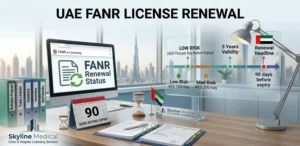
A FANR license doesn’t expire quietly but plenty of clinics still treat renewal as a formality to handle “whenever,” right
Send Us A Message
A shipment can clear customs in its country of origin, sail or fly halfway around the world, land in the UAE and still sit in a bonded warehouse, because the import permit's 60-day clock started before the vessel did.
This is the part of FANR compliance that catches suppliers off guard, not clinics.
A clinic owner thinks in terms of licenses and certificates, an importer has to think in terms of dates, transit times, and a permit window that doesn't care how far your shipment has to travel.
Get the timing wrong, and a fully documented, fully compliant shipment still ends up stuck at the port.
It's the kind of timing problem Skyline Medical for FANR approvals in the UAE helps importers get ahead of on every shipment we handle.
Here's exactly what FANR expects before your shipment leaves the origin port and what to line up before it arrives:
Get support with FANR approvals and import requirements before your equipment leaves the origin port.
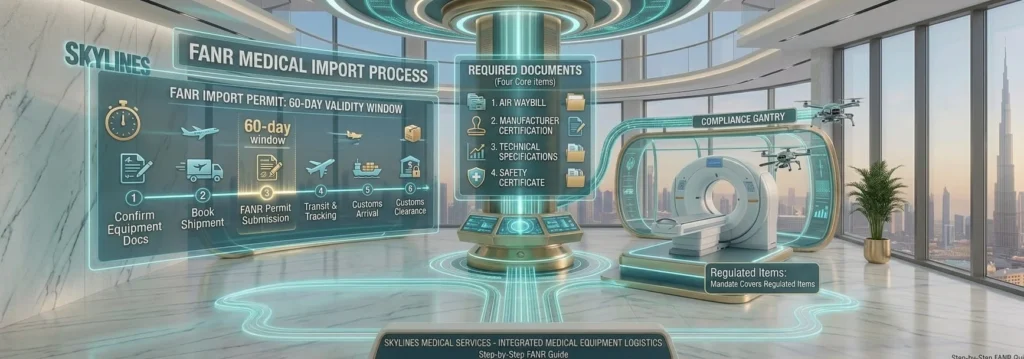
Explore FANR Approval ServicesThe FANR import approval process runs through five stages, from confirming your equipment's documentation to the shipment clearing customs and reaching the clinic and understanding this sequence upfront is what makes every detail in the rest of this guide make sense.
Most of the confusion importers run into doesn't come from any single step being complicated, it comes from not seeing how the steps connect.
The permit, the documents, and the 60-day window covered later in this guide are all pieces of the same five-stage process, not separate requirements to juggle independently.
At a glance, the process runs as follows:
Before anything is booked or submitted, confirm the equipment's manufacturer certification and technical specifications are complete and match what FANR expects to see.
This step happens before the shipment is even scheduled. Equipment that already has a documented FANR history moves through the rest of the process noticeably faster than a first-of-its-kind model with no prior track record.
Once your shipping date is confirmed, the import permit application is submitted through FANR's e-Licensing portal, timed against that specific date.
This is the step most often mistimed. The application should follow a confirmed shipping date, not precede it by months otherwise the permit's 60-day validity window risks expiring before the shipment arrives.
FANR reviews the air waybill, manufacturer certification, technical specifications, and safety certificate together before issuing the permit.
Incomplete submissions are treated the same as missing ones at this stage a review only moves quickly when all four core documents are submitted together, correctly, the first time.
With a valid, active import permit in hand, the shipment clears UAE customs against that specific consignment's documentation.
This is where the 60-day clock matters most directly: customs clearance has to happen while the permit is still valid, which is why transit-time margin needs to be built into the original timeline, not treated as a buffer to absorb later.
Once cleared, the equipment moves to the clinic for installation to the point where the import process hands off to the facility's own FANR operating license.
Clearing customs isn't the finish line by itself.
The equipment still needs to be registered against the facility's operating license where applicable, which is why coordinating the import timeline with the clinic's broader licensing status matters.
Any party bringing ionizing-radiation equipment into the UAE, a clinic, a distributor, or a reseller needs a FANR import permit, regardless of who ultimately signs for the shipment.
This surprises importers who assume the permit requirement only applies to the end user. It doesn't.
FANR's import control is tied to the regulated equipment crossing the border, not to who eventually operates it.
A distributor bringing in ten CBCT units on spec, with no clinic buyer confirmed yet, still needs a permit for that shipment holding a FANR operating license is a separate matter from holding an import permit for a specific consignment.
This applies whether you're bringing equipment in as:
Skyline Medical's Clinic & Hospital Licensing Services team can confirm before you book the shipment.
Discover NowThe FANR import permit is tied to the shipment itself, not the equipment or the importer, and it stays valid for only 60 days from issue, it is not a standing authorization you renew annually.
This is a fundamentally different structure from an operating license, and importers who are used to thinking in terms of annual renewals often misjudge it.
Every physical shipment of a radiation-generating device needs its own permit, issued against that specific consignment's documentation, which means a supplier bringing in equipment across multiple shipments over a year needs a fresh permit each time, not one umbrella approval.
If the import permit application isn't timed against the actual shipping schedule, the 60-day validity window can expire before the shipment even reaches UAE waters or airspace.
This is the single most common reason a fully compliant shipment still gets held up.
International freight timelines shift a delayed vessel, a rebooked flight, a manufacturer's dispatch delay and none of that pauses the permit's clock.
Suppliers who treat the import permit as a document to file “eventually” rather than something timed against a confirmed shipping date are the ones who end up reapplying mid-transit.
Sea freight from Europe or the US can run four to six weeks before it even reaches a UAE port, and that's before customs processing, inland transport, and installation scheduling are added on top.
Against a 60-day permit window, there's realistically only a narrow margin for anything to go wrong which is exactly why permit timing deserves the same attention as the equipment specification itself, not an afterthought handled once the shipment is already en route.
A complete FANR import permit application rests on four core documents, and missing any one of them is the most common reason an application stalls before review even begins.
These documents exist to answer one question for FANR's reviewers: exactly what is entering the country, and is it safe to move through UAE ports and airspace.
Vague or incomplete technical documentation is treated the same as missing documentation, it doesn't get the benefit of the doubt during review.
It helps to think of these four documents as answering four separate questions FANR needs settled before a shipment moves:
The air waybill confirms what is physically travelling and how, the manufacturer's certification confirms the equipment is what it claims to be, and the technical specifications tell the reviewer exactly how much radiation the device is capable of generating.
In addition, the safety certificate confirms the unit meets the relevant safety standard before it ever reaches a UAE facility.
Each one closes a different gap, which is why submitting three out of four rarely speeds up review, it just shifts where the request for missing information comes from.
A complete import permit application typically includes:
Suppliers working with our Medical Devices Supplier Middle East team already have this documentation trail in place for the equipment we distribute one less variable to chase during a live shipment.
Yes, a local supplier can submit the FANR import permit application on a clinic's behalf, provided they hold a valid purchase order from that clinic.
This is a detail a lot of clinic owners don't realize, and it matters operationally: it means the clinic doesn't have to personally navigate the e-Licensing portal for every shipment.
An established supplier with a purchase order in hand can manage the permit application, the shipping documentation, and the customs coordination as a single workflow which is exactly the kind of process a supplier who imports regularly has already refined.
Our Authority Requirements category reflects equipment we've already carried through this exact import process for UAE clinics.
A shipment that arrives without a valid FANR import permit gets held at customs pending clarification, and every day it sits there adds cost and delay on top of the equipment purchase itself.
This is the scenario that turns a straightforward equipment order into a budget and timeline problem.
Once a shipment is flagged, resolving it isn't instant, documentation has to be reviewed, and if the 60-day window has already lapsed, a fresh application may be required before the shipment can move at all.
For an importer, this is rarely just paperwork inconveniences its capital sitting idle.
A crash cart or nebulizer held at customs is an annoyance; an X-ray unit or CBCT scanner held at customs is a treatment room that can't open, a signed lease already running, and a clinic owner asking daily for an update you don't have yet.
Building customs-hold scenarios into your risk planning, rather than treating them as a rare edge case, is what separates suppliers who manage imports calmly from those who scramble every time.
The most common consequences include:
Skyline Medical's Technical Services team can step in on active shipments and ongoing equipment support alike.
A successful FANR import isn't decided by how complete your paperwork is it's decided by whether that paperwork was timed correctly against a real shipping date.
Confirm your documentation before you book freight, submit the permit application once that date is locked, and track the 60-day window like it's part of your shipping schedule, because it is.
Suppliers who treat import permits as a logistics problem, not just a compliance checkbox, are the ones whose equipment reaches the treatment room on schedule instead of sitting in a bonded warehouse.
The validity window runs from the date FANR issues the permit, which is why the application needs to be timed against your confirmed shipping date rather than submitted well in advance “just to be safe.”
This depends on how the shipment and its documentation are structured; confirm the scope of coverage with your permit application rather than assuming multiple units are automatically included.
If the permit expires before the shipment clears, a fresh application is typically required — which is why building transit-time margin into your original timeline matters more than the paperwork itself.
Yes, the import permit requirement is tied to the equipment’s radiation-emitting function, not its purchase condition, so used and refurbished units follow the same process.
Yes, as a supplier with an established purchase order relationship, we can manage the import permit application alongside the shipping and customs coordination.
No account yet?
Create an Account