FANR License for Dental X-Ray & Intraoral Sensors: What Buyers Must Check

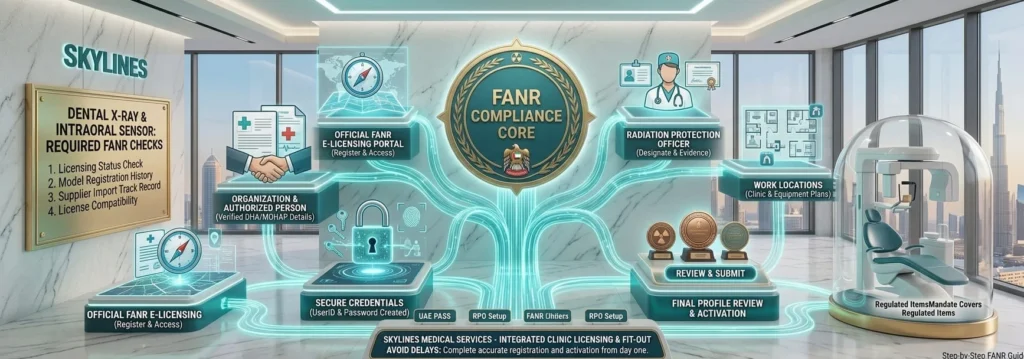
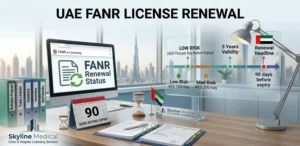
Comprehensive digital process diagram outlining compliance steps for securing a FANR License for Dental X-Ray & Intraoral Sensors by Skylines Medical Services.

Table of Contents

More Posts

Send Us A Message

Share:

Buying a dental X-ray unit or intraoral sensor in the UAE without checking its FANR status first is how clinics end up with a brand-new machine sitting in a storeroom instead of a treatment room.

We've watched it happen: a clinic invests in an internationally certified imaging system, everything looks perfect on paper, and then the import permit application stalls because the exact model's technical documentation doesn't match what FANR License for Dental X-Ray & Intraoral Sensors.

The equipment isn't faulty, the purchase simply happened before the compliance check did.

Before you sign a purchase order, here's exactly what to verify:

  • Whether the equipment even needs FANR licensing
  • What to check before you buy
  • What happens if you skip this step
  • The real difference between the sensor and the radiation source

Buying imaging equipment for your UAE clinic?

See how Skyline Medical supports equipment selection, documentation, and technical readiness.

Explore Skyline Medical

QUICK ANSWER

  • Any device that emits ionizing radiation intraoral X-ray, panoramic, cephalometric, or CBCT needs FANR licensing.
  • Before buying, check the manufacturer's technical certification, the model's FANR registration history, your supplier's import permit track record, and compatibility with your existing license.
  • Non-compliant equipment risks a rejected import permit, customs holds, or an outright inability to add the device to your license.
  • The intraoral sensor is the imaging detector, not the radiation source the X-ray generator is what FANR licenses first.

Does Every Dental X-Ray and Intraoral Sensor Need FANR Approval?

Yes, any device that emits ionizing radiation needs FANR licensing, and the digital sensor that works alongside it is documented as part of the same regulated imaging system.

This isn't a grey area or a matter of clinic size. FANR's mandate covers X-ray generators as a category, which means the equipment itself, not how often you plan to use it, is what triggers the requirement. 

A single-chair practice buying its first intraoral unit faces exactly the same obligation as a multi-branch radiology group.

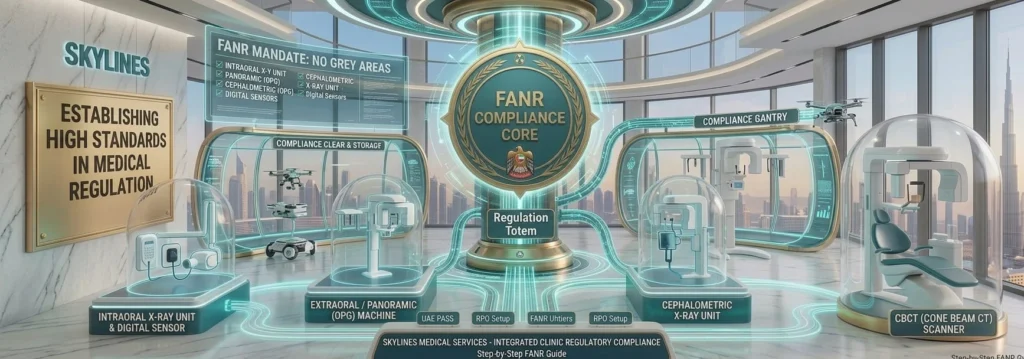
This covers the full range of imaging equipment sold for dental use:

  • Intraoral X-ray units (with digital sensors)
  • Extraoral / Panoramic (OPG) machines
  • Cephalometric X-ray units
  • CBCT (Cone Beam CT) scanners
Futuristic 3D infographic illustrating the coverage of a FANR License for Dental X-Ray & Intraoral Sensors by Skylines Medical Services.

Not sure if your existing equipment already needs FANR approval?

Talk to Skyline Medical's Clinic & Hospital Licensing Services team before you buy anything new.

Talk Now

What Should You Check Before Buying FANR-Related Equipment?

Run four specific checks before you commit to a purchase order: the manufacturer's certification, the model's FANR registration history, your supplier's import track record, and whether the device fits your existing license.

Most equipment-related compliance problems trace back to skipping one of these four checks, not to the equipment itself being unsuitable.

 A device can be internationally certified and still create weeks of delay in the UAE if nobody confirmed it against FANR's specific documentation expectations before the purchase order was signed.

Run through these four checks with any supplier before you commit:

  • Manufacturer's Technical Certification
  • FANR Registration History of the Model
  • Your Supplier's Import Permit Track Record
  • Compatibility With Your Existing FANR License

Manufacturer's Technical Certification: What It Actually Proves

A manufacturer's technical certification confirms the equipment's specifications but it is not a substitute for FANR's own licensing approval.

CE marking, FDA clearance, or an ISO certificate tells you the device meets international manufacturing and safety standards.

 It does not tell FANR anything on its own, you still need to submit the equipment's technical specifications as part of your license or import permit application.

Treat manufacturer certification as a prerequisite, not a finish line.

FANR Registration History: Has This Exact Model Been Registered Before?

Equipment models with a prior FANR registration history move through the import and licensing process noticeably faster than models being introduced to the UAE market for the first time.

When a specific make and model has already been through FANR's technical review even for a different clinic the documentation trail exists and the assessor already understands the device's radiation output profile. 

A first-of-its-kind model, by contrast, may require more detailed technical submissions simply because there's no established reference point.

Your Supplier's Import Permit Track Record

A supplier with an established history of successful FANR import permits will get your equipment through customs and into your clinic significantly faster than one applying for the first time.

This matters more than most buyers realize.

The import permit application depends on documentation the supplier controls waybills, manufacturer certificates, and technical specifications formatted the way FANR expects. 

A supplier that's done this dozens of times avoids the back-and-forth that a first-time applicant almost always hits.

Does the Equipment Match What's on Your FANR License?

Any new device must align with the regulated activities and purposes already listed on your FANR license, or you'll need to amend your license before the equipment can be added.

Clinics sometimes assume that holding any FANR license covers whatever equipment they buy next. It doesn't.

 If your current license doesn't already list the relevant purpose or activity for the new device category, you're looking at a license amendment on top of the equipment purchase which is worth knowing before you order, not after.

Browse our Scanner and Intraoral Sensors categories every unit we supply comes with the technical documentation your FANR application needs.

What Happens If You Buy Equipment That Isn't FANR-Ready?

Buying equipment without confirming FANR readiness risks a rejected or delayed import permit, equipment held at customs, or an outright refusal to add the device to your existing license all after the money has already left your account.

This is the scenario every clinic owner wants to avoid: capital committed, equipment shipped, and then a compliance gap surfaces that nobody caught during the purchase decision.

 Unlike a documentation mismatch you can quickly correct, an equipment-level compliance gap can mean the device physically cannot be used until the paperwork catches up or in some cases, until different equipment is sourced entirely.

The most common consequences we see include:

  • Import permit application rejected or delayed
  • Equipment held at customs pending clarification
  • Inability to add the device to your existing FANR license
  • Capital tied up in equipment you can't legally operate yet

Already have equipment stuck in FANR limbo, or unsure if your current setup is fully compliant?

Skyline Medical's Technical Services team can help you resolve compliance gaps before they become bigger problems.

Discover Now

Intraoral Sensors vs. the X-Ray Source: Does FANR Treat Them Differently?

Yes, the intraoral sensor is a digital imaging detector, not a source of ionizing radiation.

FANR's licensing is based on the X-ray generator, with the sensor documented as part of the same imaging system.

This distinction matters more than it might seem.

An intraoral sensor captures the X-ray image the same way digital film once did, it doesn't produce radiation on its own. 

The actual regulated item is the X-ray tube or generator that creates the ionizing radiation in the first place.

 In practice, this means your FANR application centers on the radiation-generating unit, while the sensor's specifications are included as supporting technical detail for the same imaging setup, not licensed as a separate radiation source.

A few distinctions worth remembering when you're evaluating equipment:

  • The X-ray generator is the regulated radiation source
  • The intraoral sensor is the imaging detector, documented alongside it
  • Sensor brand and X-ray unit brand don't need to match for compliance purposes
  • Both still need to appear in your equipment's technical documentation

Planning a new imaging room or upgrading your layout?

Skyline Medical's Medical Fit-Out & Interior Design team designs around your FANR shielding requirements from the first floor plan.

Explore Medical Fit-Out & Design

Your Pre-Purchase FANR Checklist, Summarized

The real cost of a dental X-ray or intraoral sensor isn't the price on the quotation, it's whether you can legally switch it on the day it arrives. 

Confirm the manufacturer's certification, check the model's FANR registration history, vet your supplier's import track record, and make sure the device fits what's already on your license before you commit. 

Get those four checks right, and equipment that shows up ready to work stays that way from day one, instead of sitting boxed up while the paperwork catches up.

1. Does a used or refurbished X-ray machine still need FANR approval?

Yes. FANR licensing is tied to the equipment’s radiation-emitting function, not its age or purchase condition used and refurbished units still require the same licensing and import documentation.

2. Can I return equipment if it fails FANR registration?

This depends entirely on your supplier’s return policy, which is exactly why working with a supplier experienced in FANR documentation matters before you commit to a purchase.

3. Does the sensor brand need to match the X-ray unit brand for FANR purposes?

No. Since the sensor is documented as part of the imaging system rather than licensed as a separate radiation source, brand matching isn’t a FANR requirement.

4. Who provides the technical documentation, the manufacturer or the supplier?

Typically both: the manufacturer issues the original technical specifications and certification, while your supplier compiles and formats that documentation for your FANR application.

5. Does adding a new device always require a license amendment?

Only if the new equipment falls outside the regulated activities or purposes already listed on your current FANR license otherwise it can typically be added under your existing license.

The Author’s Profile

  • Name: Malik Abu Shamaa

  • Profession: Biomedical Engineer

  • Experience: 7 years 

  • Expertise: Certified KaVo Expert

Equip Your Clinic with Trusted Devices

Recommended Products from Skyline