FANR License Renewal in the UAE: Deadlines, Documents & How to Avoid Penalties

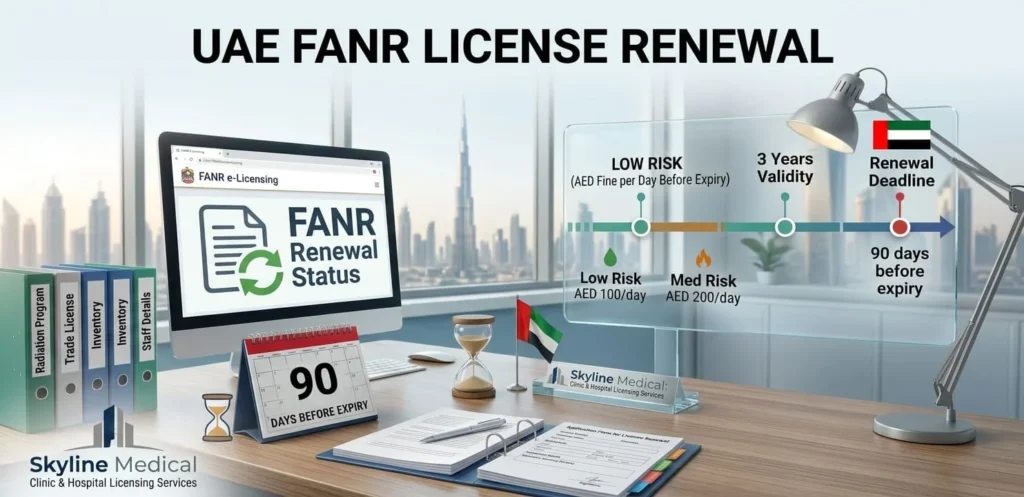
Infographic timeline and desktop setup illustrating the process and deadlines for FANR License Renewal in the UAE by Skyline Medical.

Table of Contents

More Posts

Send Us A Message

Share:

A FANR license doesn't expire quietly but plenty of clinics still treat renewal as a formality to handle “whenever,” right up until the equipment they've been operating for three years is suddenly unlicensed.

This is a different kind of risk than a first-time application.

You're not starting from zero, you already know the process, the portal, and your Radiation Protection Officer. 

That familiarity is exactly what makes renewal easy to underestimate. 

Clinics that treat it like a routine trade-license renewal, rather than a regulatory deadline with its own filing rule, are the ones who end up scrambling in the final weeks.

It's a deadline Skyline Medical's FANR compliance team in the UAE tracks for clients as a matter of routine because by the time a lapse becomes visible, it's already a problem.

Here's exactly when to start, what FANR License Renewal in the UAE asks for, and what's at risk if you wait too long:

  • When renewal should actually start
  • The documents FANR expects at renewal
  • What counts as a “change” you must disclose
  • What happens if the license lapses

Planning your next compliance step?

Explore Skyline Medical’s healthcare solutions for equipment, regulatory support, and technical readiness across the UAE.

Explore Skyline Medical

Quick Answer

  • FANR requires renewal applications at least 90 days before the license's expiry date (FANR-REG-29, Article 17).
  • There is no official grace period late renewal triggers per-day administrative fines.
  • Renewal documentation closely mirrors the initial application, including the Radiation Protection Program.
  • Any equipment, facility, or Radiation Protection Officer changes must be disclosed at renewal, not left for later.

When Should You Start Your FANR License Renewal in the UAE?

FANR Approval requires renewal applications to be submitted at least 90 days before the license's expiry date, this is a stated regulatory requirement, not a suggestion.

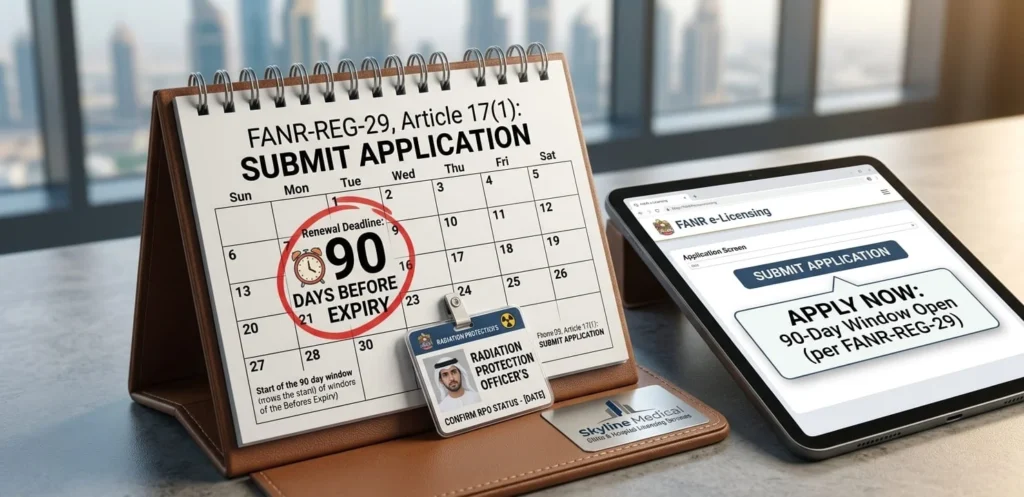
This comes directly from FANR-REG-29, Article 17(1), which is explicit: the licensee must submit a renewal application at least 90 days before expiry. 

FANR's own e-Licensing portal reflects this too, the renewal option becomes available roughly three months before your license's expiry date, which lines up with the same 90-day window. Treat this as a hard filing deadline, not a rough guideline you can push closer to the wire.

Treat renewal like any other regulatory deadline on your calendar:

  • Mark the 3-year expiry date the moment your license is issued
  • Start gathering updated documents at least 90 days out
  • Confirm your Radiation Protection Officer's status is still current
Alt Text: Calendar and digital screen setup highlighting the 90-day submission deadline for FANR License Renewal in the UAE according to regulation FANR-REG-29.

Why Waiting Until the Last Month Is Risky

Reviewing your documentation ahead of the 90-day window is what gives you time to fix gaps. 

An expired trade license or a changed Radiation Protection Officer are easy problems only if you catch them early.

FANR's own FAQ page notes that licensing applications typically take two to three months to process once correctly completed and that the clock doesn't start until your submission is in order.

 Discover a documentation gap in week two of a 90-day window and you still have room to correct it.

Discover it in week twelve, and you're filing late by definition.

There's a second, quieter cost to last-minute renewals too:

rushed applications are more likely to have exactly the kind of small mismatches an outdated trade license copy, a Radiation Protection Officer whose details have changed that trigger a request for more information from FANR. 

Each round of correspondence adds days you don't have if you started late, turning what should have been routine paperwork into a genuine race against the expiry date.

What Documents Does FANR Require for Renewal?

Renewal documentation closely mirrors your original application including trade license proof, your Radiation Protection Officer's details, and your Radiation Protection Program rather than being a lighter, confirmation-only process.

This surprises clinics that assume renewal means simply re-confirming an already-approved file.

 FANR's official renewal service lists the same core categories as a first-time application: organizational documents, Responsible Person and Contact Person information, Radiation Protection Officer confirmation, technical information on your regulated equipment, and Radiation Protection Program documentation compatible with your current activity.

 FANR also applies a risk-based review, which can include a fresh inspection depending on your facility's classification renewal is not guaranteed to skip technical scrutiny.

This is worth planning for financially as well as administratively.

If your renewal happens to fall due for a pre-licensing inspection, that's a site visit to schedule around clinic hours, not just a document upload, another reason the 90-day window matters more than it looks on paper.

At renewal, expect FANR to ask for:

  • An updated, valid trade license
  • Confirmation of your current Radiation Protection Officer
  • Disclosure of any equipment or facility changes since the last license
  • Updated Radiation Protection Program documentation

Has Anything Changed Since Your Last License?

Any change to your equipment, facility, or Radiation Protection Officer since your last license must be disclosed as part of renewal it isn't something you can address later.

This is where clinics most often trip up, because renewal doesn't work like copying the previous file forward. 

If you've added a CBCT unit, moved the imaging room, or changed your nominated Radiation Protection Officer at any point in the last three years, that needs to be reflected in the renewal application itself, not treated as a separate update to handle afterward. 

Submitting a renewal that quietly omits a known change is a common, avoidable way to trigger a request for more information mid-review.

It helps to think of your renewal application less as a status update and more as a fresh snapshot of your facility as it actually operates today. 

A clinic that added a second X-ray unit in year two, or switched suppliers for its Radiation Protection Program partway through the license term, needs that reflected accurately FANR's review is checking what you're actually licensed to operate against what's physically installed, not against what the original 2023 application said.

What Happens If Your FANR License Lapses?

There is no official grace period UAE law prohibits operating regulated equipment without a valid license, and FANR's current penalty framework attaches a per-day fine to late renewal, scaled by your facility's risk category.

This is worth taking seriously, because the penalty structure is now explicit rather than theoretical. 

Under Cabinet Resolution No. 131 of 2025, failing to submit renewal documents within FANR's determined timeframe carries a daily fine that accumulates until resolved, capped by risk category:

Risk Category Late-Renewal Fine
Low-Risk License
AED 100/day, up to AED 3,000
Medium-Risk License
AED 200/day, up to AED 6,000
High-Risk License
AED 300/day, up to AED 9,000

Beyond the fines, operating on an expired license carries the same underlying risk as operating without one at all there's no confirmed provision allowing continued operation while a late renewal is under review, so the safest position is to have your new license issued before the old one lapses, not to treat the review period as a buffer.

Already past your renewal window, or want it handled before it becomes urgent?

Skyline Medical's Technical Services team supports clinics through renewals and ongoing equipment compliance alike.

Discover Services

How to Avoid Renewal Penalties: A Practical Checklist

Avoiding renewal penalties comes down to turning renewal into a scheduled routine rather than a reaction to an approaching deadline.

None of the individual steps here are complicated, the risk comes entirely from timing.

A clinic that reviews its FANR status once a year, rather than once every three years under pressure, rarely faces a late-renewal fine at all.

This is also where working with a supplier who tracks these dates as part of ongoing equipment support pays off.

 A single compliance calendar covering your FANR expiry, your DHA or DOH facility license, and your equipment maintenance schedule catches conflicts like a renewal deadline landing in the same month as a planned equipment upgrade long before they become a scramble.

A workable renewal routine looks like this:

  • Calendar the expiry date the day the license is issued
  • Review documentation status annually, not just before renewal
  • Flag any equipment or staffing changes as they happen
  • Submit the renewal application at least 90 days ahead, with margin to fix gaps

If a renewal coincides with a facility expansion, coordinating it with Medical Fit-Out & Interior Design keeps your shielding and layout documentation aligned with what FANR reviews.

Renewal Is a Calendar Problem, Not a Paperwork Problem

Nothing about FANR license renewal is technically difficult once you've been through the process once the entire risk sits in timing.

File at least 90 days before expiry, treat the required documentation as seriously as you did the first time, and disclose every equipment or personnel change as it happens rather than at the last minute.

The clinics that struggle with renewal are rarely the ones with complicated facilities, they're the ones who let a three-year runway shrink to a three-week scramble.

Build renewal into your calendar the day your license is issued, and it stops being a compliance risk and becomes exactly what it should be: routine paperwork with a known deadline.

1. How long before expiry should I submit my FANR renewal?

At least 90 days before your license’s expiry date, per FANR-REG-29, Article 17(1) this is a stated regulatory requirement, not a general guideline.

2. Does a renewed license get a new 3-year term, or extend the old one?

FANR licenses run on a 3-year validity cycle, but FANR has not published specific guidance on whether a renewed term begins fresh from the renewal date or the original issue date; confirm this detail directly with FANR for your specific license.

3. Do I need a new technical assessment if my equipment hasn't changed?

FANR applies a risk-based review to renewals, which can include a fresh assessment depending on your facility’s classification renewal isn’t guaranteed to be a documents-only process even without equipment changes.

4. Can I keep operating while my renewal is under review?

FANR has not published a provision confirming continued operation on an expired license while a renewal is under review, so the safer approach is ensuring your new license is issued before the old one lapses.

5. What if I missed my renewal deadline already?

Contact FANR and begin the renewal process immediately late renewal carries per-day administrative fines, and further delay only increases the exposure.

6. Does opening a FANR account mean I already have a FANR license?

No. Account activation provides access to e-Licensing functions. A FANR license is a separate regulatory authorization that requires its own application and review.

The Author’s Profile

  • Name: Malik Abu Shamaa

  • Profession: Biomedical Engineer

  • Experience: 7 years 

  • Expertise: Certified KaVo Expert

Equip Your Clinic with Trusted Devices

Recommended Products from Skyline